
Witches’ Brew
The third quarter of 2026 is in the books, and while there were several factors that had outsized impact on markets during the last three months, there’s no dispute about what the biggest one was, and that was the sharp increase in global interest rates. Yields rose across the globe, with the yield on the widely followed benchmark Bloomberg Global Agg index climbing 62 basis points, moving from 3.82% to 4.44%.
Meanwhile, in the U.S., the 10-year Treasury yield climbed from 4.48% to 5.29%, an increase of 81 basis points, the largest quarterly increase in decades. Rates have continued to climb since quarter- end, with yields on the 30-year hitting 5.73% at the time of this writing, and with 30-year mortgage rates approaching 7.50%.
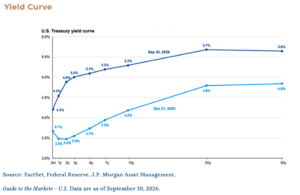
Bond yields are a lot less sexy to write about than just about anything; not much could be more boring, but not much could be more important. As Warren Buffett famously observed, interest rates—the prices of money—are very much to asset prices like gravity to the apple. The higher the rate, the stronger the gravitational pull. When money costs more, it is axiomatic that asset prices come under pressure.
Isn’t it?
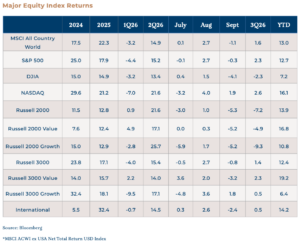
While bond prices fell across the globe, major equity indices finished higher, with global stocks rising 1.6% during the quarter, and the S&P 500 returning 2.3%. However, in the case of the S&P 500, the gains were once again concentrated among a group of large tech stocks (a Who’s Who of AI and hyperscaler names such as Microsoft, NVIDIA, Apple, Meta and Palantir). Under the surface, most stocks in the index (307 to be exact) were lower, with a median return of -3.9%.
While the Magnificent 7 were a mixed bag, the long AI trade was back in full force during the quarter as investors flocked to companies seen as safe earnings growers. Outside of the AI darlings, stocks were generally lower. Small caps were among the hardest hit, with the Russell 2000 down more than 7%. Value tended to outperform growth among large caps and small caps. This year’s healthy broadening of the equity rally has faded somewhat amid the stirrings of a witches’ brew of unfavorable macro forces.
Double, double toil and trouble;
Fire burn and cauldron bubble.
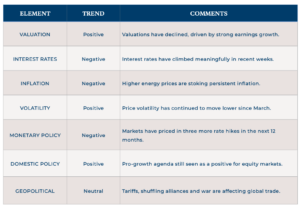
The first ingredient in this most unfortunate unction is energy prices. The catalyst for these macro headwinds is unquestionably the prolonged conflict with Iran. The closure of the Strait of Hormuz sent oil prices soaring, and while the price of crude abated as peace talks progressed over the summer, crude prices have since rebounded amid renewed hostilities and tightening inventories. Even though shipments through the Strait have been reported to be near pre-war levels, price relief has been muted because of depleted inventories, expensive transport (tanker shortages, insurance costs, longer routes), damaged refineries and bottlenecks. While the U.S., as a net energy exporter, has not felt the full brunt of these issues, most of the rest of the world has, and the resultant inflationary pressure has contributed to higher bond yields across the globe.
Fillet of a fenny snake,
In the cauldron boil and bake…
Prior to the breakout of war, markets had been anticipating lower short-term interest rates, but the oil shock triggered a synchronized global tightening response. Concerns about inflationary pressures forced central banks to adopt more hawkish positioning. What’s been interesting, though, is that while inflation has certainly heated up, with the August CPI growth reading at 3.4%, markets are still treating this increase as short-term. There’s been very little movement in long-term inflation indicators (such as the breakeven between 5-year or 10-year Treasuries and corresponding inflation-protected Treasury securities (TIPS). Long-term breakeven inflation is still sitting stubbornly at about 2.4%. However, once higher oil prices dislodged the rate-cut consensus, the bond market began to reprice itself on its own. Interest rates have gone up, and while inflation was the catalyst, what’s keeping rates higher is something more than just inflation—resurgent term premiums, driven by numerous factors, including rising concerns about debt and deficit spending, pressures on the market stemming from a mountain of expected new debt issuance to pay for AI-related capex and finally, and perhaps most intriguingly, uncertainty about the impact of AI in general.
Eye of newt and toe of frog,
Wool of bat and tongue of dog…
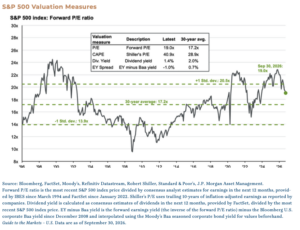
We’ve all heard the tale of the frog in a pot of boiling water; the water boils only gradually, and the frog doesn’t notice until it’s too late. Well, this market does not appear to be near a boiling point, but these higher rates are already having an impact even if they are not obvious yet. Despite indices such as the S&P 500 continuing to make new highs during the third quarter, price/ earnings ratios have declined. The earnings bonanza among top constituents such as Microsoft, NVIDIA, Meta and Apple boosted the entire index and camouflaged a fairly significant valuation decline YTD, with the forward P/E falling from north of 22.0x at the beginning of the year to about 19.0x.
Some of this can be chalked up to the market treating some AI profits as temporary—the result of a boom causing supply shortages and enormous pricing power in areas such as semiconductors—and not rewarding these companies with a higher multiple that would reflect higher long-term growth. On the other hand, some of this is the “gravity” that Buffett described.
When money costs more, it’s harder to pay up for share prices.
Adder’s fork and blind-worm’s sting,
Lizard’s leg and howlet’s wing…
So, back to the witches’ brew of what’s driving rates higher. Inflation fears certainly catalyzed the new base expectations for interest rates and brought renewed attention to more structural issues facing the bond markets.
The first is the most serious long-term issue, and of course, the most intractable: runaway government spending. With national debt at $40 trillion and an annual deficit of roughly $2 trillion, or about 6% of GDP, the financial health of the U.S. is gradually but steadily becoming a source of investor heartburn. The federal government’s annual net interest bill has more than doubled since fiscal 2022—from about $475 billion to roughly $1 trillion. Of course, this is not just a U.S. issue. Higher interest rates are putting stress on borrowers around the world. France, which, unlike the U.S., is not growing its economy at the moment, has seen its borrowing costs rise alarmingly just in the last month amid growing social unrest. Borrowing costs for France currently exceed Greece—GREECE!
Second, markets are beginning to price in a mountain of new debt issuance, chiefly by hyperscalers and other AI-related companies, to finance AI investment during the next several years. According to Bloomberg, capital expenditures by just five hyperscalers (Alphabet, Amazon, Meta, Microsoft and Oracle) will approach a total of $3 trillion during the next three years, with a growing share of that sum being funded by debt instead of equity. By comparison, the national defense budget of the United States is about $1 trillion. That’s a lot of supply.
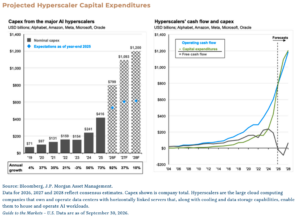
Not only is this an enormous amount of new investment that would naturally apply some upward pressure on yields under any circumstances, but the spending itself is also inflationary on the margin. Data centers require construction materials and equipment, skilled labor, electricity and financing. Where capacity for any of these inputs is constrained, prices can be expected to rise.
The AI boom has grown from being a curiosity (as it was when ChatGPT was launched in November, 2022) into an economic colossus bigger than the national defense budget. The true impact of this technology on the economy is still, of course, unknown—it may be that productivity gains associated with AI are structurally deflationary. However, in the near term, it appears that AI can be inflationary. The demand for physical resources arrives immediately; the additional productive capacity may take a while.
In the meantime, it seems, it may be the case that not only are the hyperscalers and chipmakers enjoying the lion’s share of corporate earnings growth, but they may be contributing to higher expenses for much of the rest of the stock market.
There is a tension developing between the extraordinary optimism surrounding AI earnings and the rising cost of capital. It would be ironic if it turned out that AI was contributing not just to higher near-term inflation, but to higher interest rates through stronger investment demand.
For a charm of powerful trouble,
Like a hell-broth boil and bubble…
This week, OpenAI announced that after siccing its agents on hundreds of heretofore unsolvable math problems, they had solved 377 of them across a broad array of topics including algebra, number theory, computer science and mathematical logic. Some observers are already referring to October 6 as Math Armageddon. One mathematician I know put it this way: “We’re cooked.”
Perhaps that’s an in-the-moment overreaction, but perhaps not, and if AI has, in a few hours, obliterated the field of mathematics, where some quite bright people with useful skills are known to reside, what does this mean for the rest of us? How will deployment of these models across the economy not prove to be incredibly disruptive, if not actually physically dangerous? On the other hand, AI could help us cure deadly diseases and do other wonderful things. The set of potential outcomes facing us in the next few years is enormous. This is not a normal distribution curve with small tails on either side but with 95% of outcomes somewhere in the middle. This set appears to have two fat tails, meaning there is a higher-than-normal chance of something really favorable happening but also a higher-than-normal chance of something really unfavorable. That, to me, is the definition of higher risk, and a set of outcomes for which an allocator would require a higher rate of return—higher interest rates.
Double, double toil and trouble;
Fire burn and cauldron bubble.
Fortunately, our investment process does not depend on figuring out which fat tail, if either, is coming to pass. As always, we will be taking what the markets offer up in the way of evidence-based sources of investment performance (our time-tested tilts toward value, small-cap and quality) across the global opportunity set. Our approach does not rely on outsized growth for outperformance over time; in fact, it tends to shine during periods in which investors shy away from expensive growth multiples. Our portfolios are often well-populated with small-cap stocks, so we certainly have some exposure to a protracted downturn, albeit with a value investor’s margin of safety and a bias toward quality. In sum, we believe we are positioned well in this environment.
As always, we thank you for your continued confidence.
Burke Koonce III
Chief Investment Strategist
bkoonce@trustcompanyofthesouth.com
Daniel L. Tolomay, CFA
Chief Investment Officer
dtolomay@trustcompanyofthesouth.com
Disclosures
This communication is for informational purposes only and should not be used for any other purpose, as it does not constitute a recommendation or solicitation of the purchase or sale of any security or of any investment services. Some information referenced in this memo is generated by independent, third parties that are believed but not guaranteed to be reliable. Opinions expressed herein are subject to change without notice. These materials are not intended to be tax or legal advice, and readers are encouraged to consult with their own legal, tax, and investment advisors before implementing any financial strategy.
