
Tech Wreck
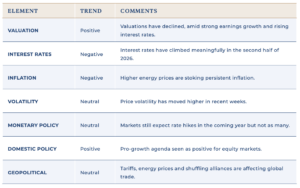
Markets were uneven in October, with significant cracks occurring in “the AI trade,” as investors expressed growing doubts about the economic realities of the AI boom. Even amid an environment of surging oil prices and rising inflation, investors increasingly sought safety, with treasuries rallying and value stocks dramatically outperforming.
The tech-heavy NASDAQ 100 is now down more than 10%, putting it in correction territory. While enthusiasm for all things AI-related has supported gains in major market indices this year, those gains have been quite concentrated, with sectors such as semiconductors up more than 50% on the year through the end of October. October was gloomy for AI, with semis down more than 15%, taking indices lower.
While semiconductor stocks and other AI-related companies reported some jaw-dropping quarterly financial results (e.g., Alphabet’s 25% quarterly revenue growth and Amazon’s AWS 39% revenue growth), these significant successes were overwhelmed by the massive capital expenditures these companies are making to sustain this growth. Shares of both companies were lower, Alphabet in particular, down 19%. Such is the curse of high expectations.
Along with high expectations, the AI sector is also now having to contend with a second bogeyman, the bond market. Interest rates rose dramatically during the third quarter amid rising inflation and expectations of a massive supply of corporate debt coming onto the market during the next three years. Evidently, there is a limit to investor willingness to fund the AI bonanza after all if interest rates are high enough. Interestingly, interest rates actually fell fairly significantly during October, with the 10-year Treasury yield falling back below 5%, but it was not enough to undo the lost momentum among the high-fliers.
Enough with the bad news; there was also quite a bit of good news during the month. The broader market held up well as leadership rotated. Even though the S&P 500 was about a percentage point lower, most stocks in the index—actually, more than 70% of them—were higher for the month. On an equal-weighted basis, the index returned a robust 5%. Value stocks and small-cap stocks continued to benefit from the rotation away from large-cap growth. For the year, the Russell 3000 Value index is outpacing its growth counterpart by 2400 basis points. In fact, despite all the hype (and real-world benefits) around artificial intelligence, value is now outperforming growth on a one-, three-, and five-year basis.
Major Equity Index Returns
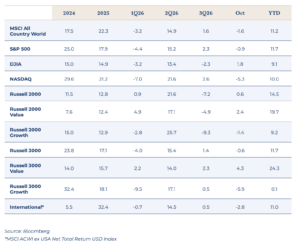
Small-cap stocks, which took a beating during the third quarter while interest rates were moving up sharply, benefited from the pullback in yields during October. They’ve been great performers in 2026, particularly small-cap value, up close to 20% on the year. Should the outlook for rate hikes continue to moderate in the coming months, we would expect this asset class to perform accordingly.
Regarding rates, regrettably, we do not have a crystal ball. However, we do not necessarily mind somewhat higher long-term rates as long as we can invest along an upward-sloping curve, positioning our clients to get paid for taking on the additional term risk. The market appears to be newly requiring higher rates for the risk of lending longer, and while this re-pricing may have been catalyzed by higher energy prices, inflation fears do not seem to be the primary culprit. If they were, we would have likely seen break-even inflation expectations (the difference between Treasury yields and inflation-protected Treasury yields) move up. We have not. The number is stuck around 2.4%. What that tells us gives us a clue not just about bonds but about stocks. If investors are charging more for long-term risk, then that is an extra hurdle for growth stocks with expected cash flows not today but in the distant future.
Broadly speaking, this market has become healthier as earnings multiples paid for stocks have come down since the beginning of the year. Furthermore, the path to lower valuation has been pretty much painless because corporate earnings growth has been so strong. However, this growth has been quite concentrated, with huge gains in semiconductors overshadowing more modest growth elsewhere. We do not want to see earnings growth stall, even if we always welcome performance in the “elsewhere” camp and giggle quietly when the high-fliers falter.
We thank you for your continued confidence.
Burke Koonce III
Chief Investment Strategist
bkoonce@trustcompanyofthesouth.com
Daniel L. Tolomay, CFA
Chief Investment Officer
dtolomay@trustcompanyofthesouth.com
Disclosures
This communication is for informational purposes only and should not be used for any other purpose, as it does not constitute a recommendation or solicitation of the purchase or sale of any security or of any investment services. Some information referenced in this memo is generated by independent, third parties that are believed but not guaranteed to be reliable. Opinions expressed herein are subject to change without notice. These materials are not intended to be tax or legal advice, and readers are encouraged to consult with their own legal, tax, and investment advisors before implementing any financial strategy.
